

Neural Convergence and Counterstrain – Inflammatory Pathways and Dysfunction

Updated: Jun 19
Article 4 of 6 of "That Was Not A Muscle" companion series
Every one of our over-seven-trillion nerve endings communicates with our brains, but this communication is not direct for most. Our bodies solve this challenge via neural convergence at a structure known as the interneuron.
Interneurons, or association neurons, serve an integrative role as they synapse, or connect, with the sensory neurons of multiple other structures in what is known as convergence. We can illustrate this interaction with the interneuron as a power strip and the converging structures as appliances.

Just as a power strip allows connecting different low-power appliances to a power source without the need of multiple dedicated outlets, the interneuron allows different physiological structures to communicate with the spine without the bulk of dedicated connections. A brief look of the most salient components allows us to contemplate why understanding Neural Convergence is fundamental in Fascial Counterstrain mastery.

1) Dorsal Horn – Back of the spinal cord region, where the sensory neurons enter to access the deeper spinal structures.
2) Interneuron – Multipolar neuron found only in the spinal cord and brain. This is where the sensory neurons from different structures converge.
3) Ventral Horn – Front of spinal cord region, where interneurons relay their message to synapsing motor neurons.
4) Convergence – Of different fascial expressions at the same interneuron via their sensory neurons, including 4a) arterial fascia, 4b) venous fascia, 4c) myofascia, and 4d) skin fascia.
5) Motor Neuron Synapses – With the interneuron at the ventral horn to produce either 5a) motor neuron activation or 5b) inhibition in musculoskeletal structures, or the smooth muscle of the vasculature and organs.
The synapsing with motor neurons is a component we’ll explore in another installment as it’ll help us understand how musculoskeletal tissues get involved during the inflammatory response. Now that we understand the components of neural convergence, it’s time to recall how the source inflammation travels from the affected interstitium all the way to the spine.
When the inflammation arrives to the dorsal horn of the spine and connects with the interneuron, it inflames it and produces neurogenic inflammation. This neurogenic inflammation then travels through all the sensory neurons connecting with the affected interneuron in a retrograde direction. Once it arrives to the structures connected to the affected neurons, it pools as retrograde inflammation and produces other loops of aberrant protective reflex arcs.
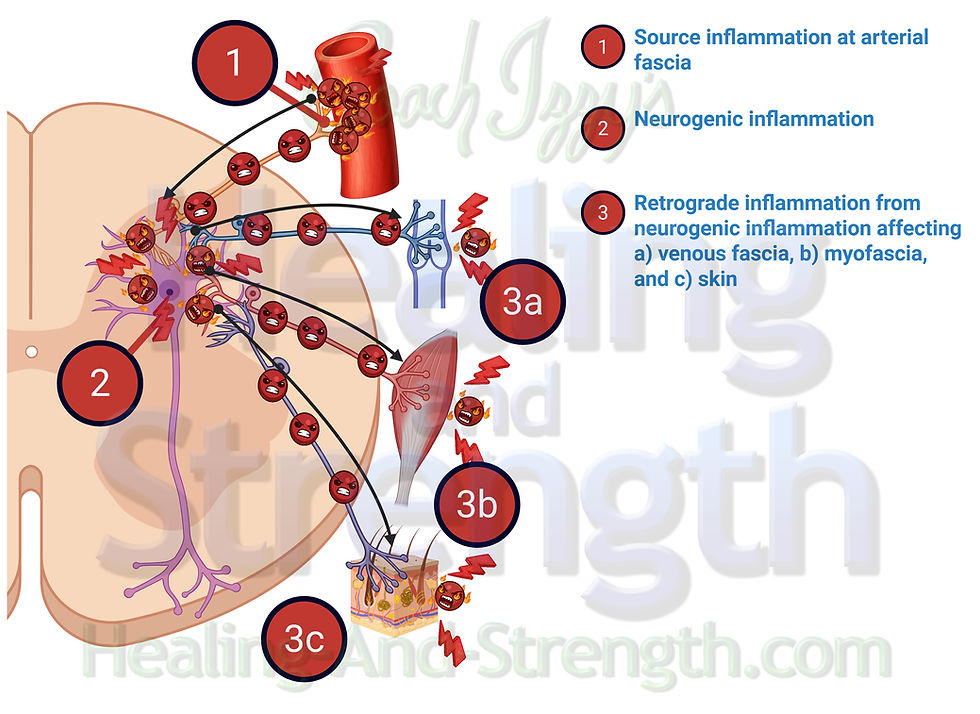
This combination manifests as pains such as hyperalgesia, which is a localized area of exaggerated sensitivity to touch, and where we usually find the source inflammation. Then there’s secondary hyperalgesia, which is a result of retrograde inflammation, and produces pain and dysfunction on uninjured tissues that won’t respond to direct treatment.
Neural convergence is even more significant when the source inflammation is neuroinflammation, that is, inflammation in the central nervous system. This results in central sensitization that can manifest as allodynia, an extreme sensitivity to pain from otherwise benign stimuli, or significant pain and dysfunction in broad areas that cannot be readily identified. Central sensitization can also affect entire physiological systems, or large segments of the body.

Neuroinflammation is usually the result of pathologies such as meningitis, or injuries and trauma we experience from accidents or sports. Not as common is direct genetic conditions such EDS or Chiari Malformation.
The central nervous system can also get inflamed, even when not directly compromised, through neural convergence. Take temporal summation, which is a single source of inflammation continuously inflaming the dorsal horn of the spine. Or spatial summation, which is what happens when multiples sources of inflammation bombard the dorsal horn at the same time.
Trapped inflammation has yet another side-effect. The extended presence of Tumor Necrosis Factor Alpha (TNF α), Interleukin 1β (IL 1β), and Interleukin 6 (IL 6) in trapped inflammation—besides disabling the local lymphatic pumps—also drive the production of Transforming Growth Factor Beta One (TGF β1).
This powerful cytokine triggers fascial contraction which creates a state of hypoxia and further inflammatory entrapment in the compromised tissues, and also changes fibroblasts—the core cells of fascial structures—into myofibroblasts. Though rare, these contractile cells occur naturally in many structures of our bodies and their transformation is a normal part of wound healing. They become problematic when the presence of IL 1β, IL 6, and TGF β1 drive the change in an inflammatory entrapment state.

Compounding to this problem, all these myofibroblasts secrete additional IL 1β, IL 6 and TGF β1 among other cytokines, thereby increasing fascial contraction and the rate of unfavorable cellular transformation. That means that under the prolonged presence of trapped inflammation, healthy tissue starts turning into fibrotic, or scar, tissue, and not just in our musculoskeletal structures but also in organs and vasculature.
There’s a reason I remind patients to acknowledge the pain but to not confuse it with the dysfunction because the source inflammation may not be where the pain is. For the pain and dysfunction to find resolution, the source inflammation driving the aberrant protective reflex arcs has to be identified and drained.
Protective reflex arcs are an essential component of our physiology and we need to appreciate their nature to understand how they’re a crucial part of our health and healing.
And that is the topic of our next installment.
Until next time, I wish you a joyous and pain-free life.

The topics in this series are covered in-depth in the book That Was Not A Muscle, available now at your favorite online book retailer. | |
 | |
All photographs, illustrations, graphics, videos, and other media contained in or associated with this publication are the intellectual property of Izzy Sanchez, Integrated Healing and Strength Systems, Inc., and Mar en Hoguera Media, LLC, and are protected under United States and international copyright laws. Unauthorized reproduction, distribution, display, modification, publication, or use of these materials in any form is strictly prohibited. Any infringement of these rights may result in civil and/or criminal penalties, and violators may be subject to prosecution to the fullest extent permitted by law. All biomedical illustrations created with BioRender. |


Comments