

That Was Not A Muscle - The Companion Posts

Updated: Jun 23
Bookmark this page for future reference
What makes Fascial Counterstrain one of the gentlest and most effective modalities is how it integrates the multiple physiological layers interacting in the presence of elements that signal harm. These layers have been carefully studied in their respective fields, but it was Brian Tuckey—the originator of the Fascial Counterstrain system—who pored over the research from all these fields and put the pieces of the puzzle together. This is what allows us to view our bodies from a different perspective and find solutions where none were thought to exist.
Fascial Counterstrain is still a relatively new field and people who could potentially benefit hesitate from the lack of mainstream information about it. In addition, the multiple layers and interactions that must be explored to understand our field are not a regular part of conventional manual therapy medicine.
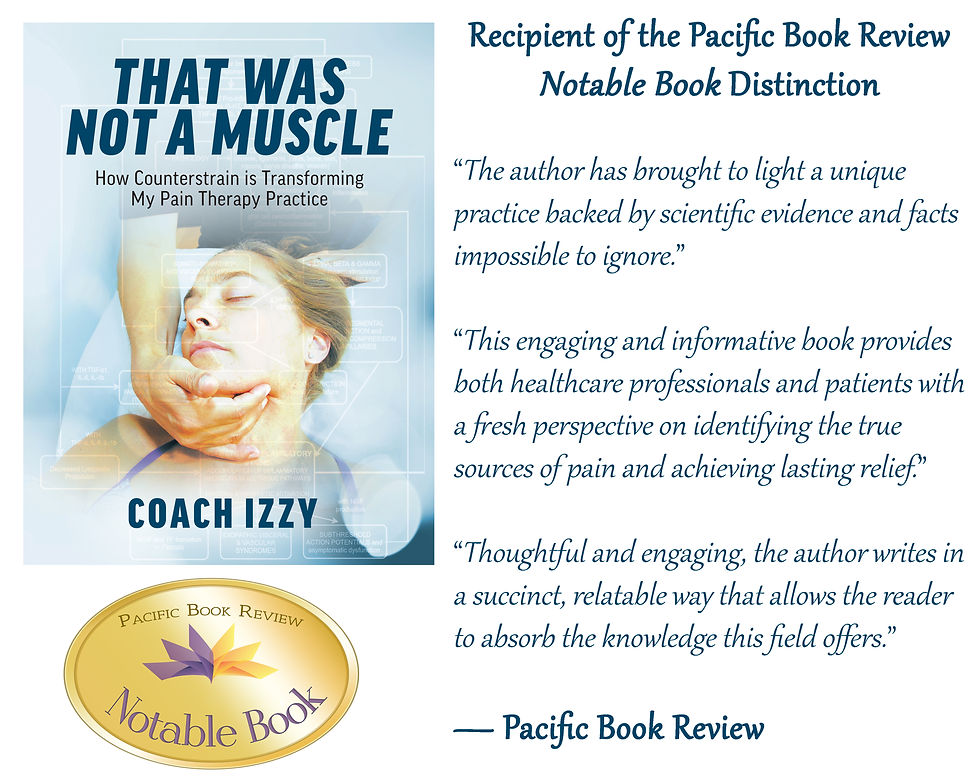
That’s one of the reasons I wrote That Was Not A Muscle. It is my objective to make all this knowledge more accessible and digestible. But keep in mind that while I simplify the concepts, I do NOT oversimplify them because doing so would destroy their essence. That means that if you truly want to get to the bottom of the interactions, you’ll have to dig deep into the resources I cite in the book.
We all have different ways of exploring knowledge and concepts. Some of us need only to read. Some of us need illustrations, some of us need animated illustrations, and some of us need all of them.
That’s why I created these companion posts. You can view them in their intended order, or you can view them individually to review specific segments. As the posts get released, their image will become a clickable link that will take you directly there.
Here’s how they’re broken down:
 |
 |
 |
 |
 |
 |
Although these posts were created to complement the book, you do not necessarily have to read it to get the most salient aspects. But if you want to explore deeper into the theoretical rational and how it dictates our methodology, then you'll enjoy the book immensely.
It's an honor to continue guiding you in exploring the many aspects that make our modality so effective and unique, but as I said before, the only way to fully understand Counterstrain is by receiving it.
Until next time, I wish you a joyous and pain-free life.

Comments